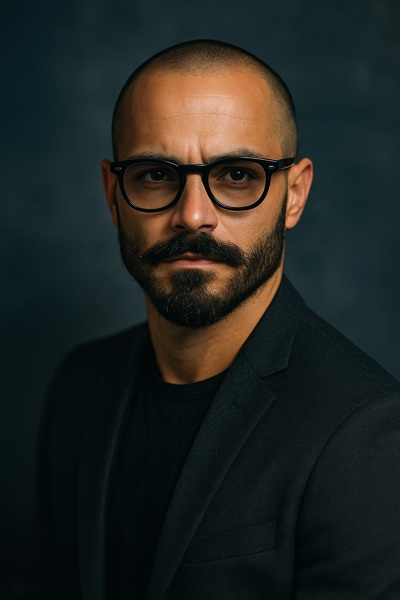
I work every day at the intersection of artificial intelligence, CRM and business process transformation.
At a multinational industrial group in the energy sector I own the roadmap of the global Salesforce platform and lead initiatives that reach thousands of users and billions of dollars of revenue. In parallel I work with companies that want to understand how to bring AI into their processes for real, to evaluate an investment in Salesforce or Agentforce, or to design agents and automation that hold up outside the demo.
I do not resell licences. I do not deliver implementations. I have no commercial incentive to recommend one technology over another. There is only one objective: getting you to the right decision.
Who advises you, and who pays them
In technology consulting almost everyone has a direct economic interest in selling you something: licences, implementation days, multi-year programmes, teams to staff. That is not a problem in itself, but it changes the meaning of every recommendation you receive: it always arrives inside a specific business model.
I am not a system integrator, I am not a reseller and I do not live off selling projects. I have no incentive to make you buy. That is why my opinion is worth something. The work is helping you separate four things:
- what genuinely makes sense to implement;
- what is only marketing;
- which investments create value;
- which projects are better not started.
Sometimes the best advice I can give you is to buy nothing at all.
What I do during the day
I own the roadmap of an international Salesforce platform and its evolution. Which means that every day I sit on the same side of the table as you: I review commercial proposals, argue investments with leadership, set roadmaps, coordinate internal teams and vendors, and in the end I have to demonstrate with numbers that the initiatives were worth something.
I have seen CRM and AI projects succeed. I have also seen multi-million programmes fail, and I have seen why - from the inside, where nobody ever writes up what went wrong. What I bring to clients is not theory: it is what I learned making real decisions in enterprise settings.
Background
- Now Global Salesforce Platform Lead & AI Product Owner Multinational industrial group, energy division
- Global platform roadmap and its strategic evolution.
- Leading a multidisciplinary team of 9.
- Setting business and technology priorities.
- Governance of CRM and AI investment, with a $1M annual project budget.
- 2024 - 2025 Lead AI Transformation & Business Architect Multinational industrial group, energy division
- Definition of the enterprise AI roadmap.
- Evaluation and adoption of Agentforce, Einstein and Data 360.
- Coordination between business units, enterprise architecture and technology partners.
- AI agent on Microsoft Teams and SharePoint: internal support tickets down by more than 30%.
- 2022 - 2024 Business Architecture Specialist Accenture
- Design of enterprise CRM architectures.
- International digital transformation programmes.
- Tier-1 clients in luxury, automotive and retail.
- Core process efficiency improved by 35% across multi-country deployments.
- 2020 - 2021 Salesforce Project Manager Seven IT
- End-to-end Salesforce implementations.
- CRM project delivery across different sectors.
The technologies I work with
These are the tools I use to assess a proposal, design an architecture and build a prototype to find out whether a hypothesis holds. It is not a list of things I install for you: execution stays with your team or with a partner.
CRM platform
- Salesforce
- Agentforce
- Einstein AI
- Data 360
Models and assistants
- OpenAI and ChatGPT
- Claude
- Gemini
- Perplexity
- Custom GPTs
- Gemini Gems
Agent building
- Relevance AI
- Lovable
- Emergent
- SharePoint Agents
- Multi-agent systems
Integration and knowledge
- APIs and AI integrations
- Enterprise knowledge systems
- Process automation
Results
Among the programmes I have contributed to:
- ~69,000 hours a year returned to the organisation through CRM and digital transformation initiatives.
- ~€1M of annual value generated by process modernisation programmes.
- Internal support tickets down by more than 30% with an AI agent built in-house, at no additional licence cost.
- Strategic roadmaps for platforms used globally.
How I work
The same four principles, whether the job is reviewing a proposal or setting up a programme inside an industrial group.
- 01 Validate first, commit second A working prototype costs days. An implementation proposal costs six figures. You test the hypothesis with the first, before paying for the second.
- 02 One use case, one number agreed upfront Just one, with the measure chosen before starting and a written criterion for stopping. Large programmes rarely fail: they continue, and absorb budget, because stopping them requires someone to admit a mistake.
- 03 Whoever can say no, named at the start Security, compliance, final authority: three names on a page before you begin. If you do not choose them at the outset, you discover them halfway through - when they say no and everything stops.
- 04 Value gets counted How many hours a process gives back, and how far the number of people asking for help to use it drops. Those are the two figures a steering committee accepts, because they can be counted. Features delivered is not a measure of value.
How much time I give to clients
My main role remains the one I hold inside the group I work for. That is why I take a limited number of clients a month, and it will stay that way: it is not a ramp-up phase, it is a structural limit. I do not do hands-on delivery and I do not do body rental.
Engagements come in six kinds:
- strategic advisory;
- solution architecture;
- technology roadmaps;
- AI transformation;
- governance;
- evaluation of investments and project proposals.
An ongoing engagement is possible only in the shape that respects that limit: two or three days a month, for a quarter, with a written end date. I prefer high-impact work with a boundary to open-ended collaboration.
To say it before it is asked: this is declared secondary work, limited by design. I do not implement, I do not resell licences, and I do not take an engagement that touches an employer's client portfolio. Published prices and a public calendar exist to make that boundary readable from outside, which is the only way a boundary counts for anything.
The objective is not to become your supplier. It is to put you in a position to decide better.